

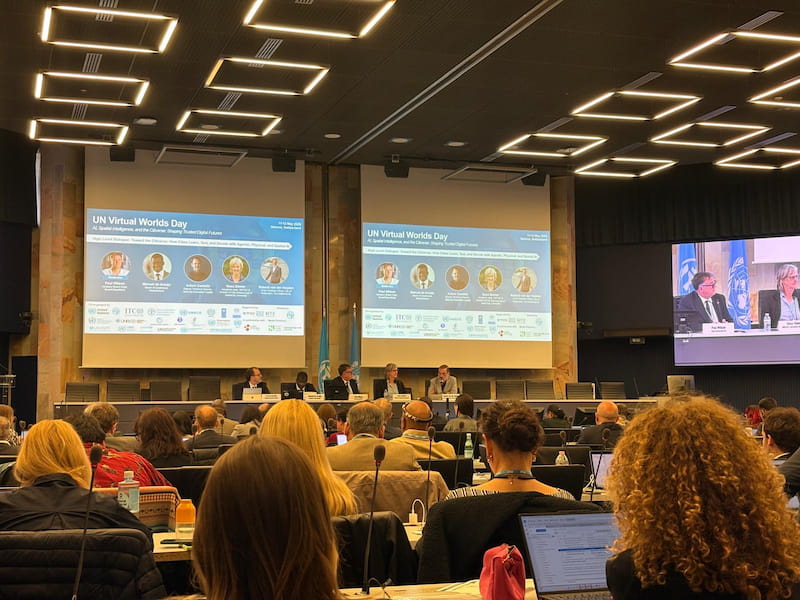
On 11 and 12 May 2026, Raffaele Gareri took part in the 3rd UN Virtual Worlds Day, hosted at the ITU (International Telecommunication Union) headquarters in Geneva.
Two days of intense discussions, bringing together governments, ambassadors, urban leaders, researchers and innovators from around the world around an increasingly central question: how artificial intelligence and spatial technologies can transform cities — and, above all, how to make this transformation reliable, equitable and truly useful for people.
For those working every day at the intersection of urban innovation, digital transformation and territorial development, it was an opportunity to observe how the international debate is evolving. Today, the conversation is no longer just about technology as infrastructure, but about technology as a tool to rethink the relationship between citizens, data, urban spaces and governance.
Let’s take a closer look.
From the “metaverse” to the “citiverse”: a shift in perspective
Among the concepts discussed most during the summit, one of the most interesting was the idea of the citiverse. To understand what it means, it is worth taking a step back.
In recent years, the metaverse has been widely discussed as a set of virtual environments where people can interact, work and socialize. The citiverse starts from a similar idea, but applies it in a much more concrete and specific way: rather than creating parallel worlds for entertainment, it focuses on building digital representations of real cities, powered by real-time data and artificial intelligence, to support better decision-making.
In practice, it is like having a living digital replica of a city, constantly updated with data on traffic, energy, climate and population, where public authorities and decision-makers can simulate scenarios and test solutions before implementing them in the real world.
What would happen to mobility if we closed a road to traffic? We can simulate it. We are planning a new neighbourhood and want to understand its impact on energy consumption or flood risks? We can test it on the digital twin before the first stone is even laid.
The goal is to move from a reactive form of governance — one that intervenes once problems have already emerged — to a predictive approach capable of anticipating them.
Although it may sound futuristic, this is not science fiction. These are real-world use cases that cities such as Rotterdam, Valencia and Tampere are already exploring, and that were at the heart of the discussions in Geneva.
A key message that emerged strongly is that the citiverse is not a technology in itself, but rather a new way of thinking about urban governance: one that is more data-driven, more capable of anticipating challenges and — perhaps most importantly — more inclusive, as it could potentially become accessible even to cities with fewer resources, provided that work continues on open and shared standards.
Why we attended… and why we will return
Taking part in events like this is not about visibility. It is about positioning and learning.
The decisions shaping how AI will be governed in cities, which standards will prevail and who will have a voice in international processes are being built in these very contexts. Being present means understanding where the world is heading before others do, and bringing that perspective into the work we carry out every day.